
Many organizations do not struggle because they lack data. They struggle because too much of that data is difficult to trust, organize, and reuse across teams. A better approach is to treat data as a product: curated, governed, and ready for downstream consumption.
That is where the bronze, silver, and gold pattern becomes especially powerful in AIDP Workbench. With the AIDP Master Catalog, catalogs, schemas, tables, volumes, notebooks, and workflow orchestration, teams can move from raw inputs to trusted data products with a clear and repeatable path.
Why the bronze, silver, and gold pattern matters
Customers want more than just a place to store data. They want a practical way to land raw data, standardize and enrich it, and publish trusted outputs for downstream teams.
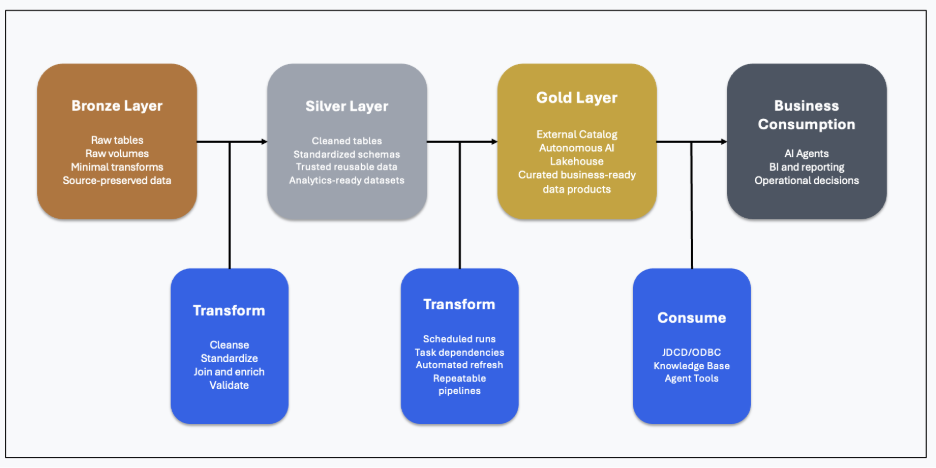
The bronze, silver, and gold model makes that lifecycle easy to understand:
- Bronze stores raw data as it arrives.
- Silver stores cleaned, standardized, and enriched data.
- Gold stores business-ready, curated data products.
This model is useful not only for implementation but also for storytelling. It gives technical teams a repeatable architecture, while providing business stakeholders with a simple way to understand how raw data becomes something trustworthy and reusable.
Bronze layer: preserving raw data
The bronze layer is the landing zone for raw data.
At this stage, the goal is not to perfect the data. The goal is to capture it, preserve it, and make it available for downstream processing. Raw files can be stored in volumes, and incoming structured data can be persisted into bronze-layer tables with minimal transformation. This matters because bronze preserves optionality. If business rules or downstream requirements change later, teams still have the original data available for reprocessing.
It also establishes a clear starting point for governance. Everyone knows where raw data begins.
Silver layer: building trusted reusable assets
The silver layer is where raw data becomes usable.
This is where teams standardize schemas, clean nulls, apply business rules, join datasets, and enrich records. In AIDP Workbench, this is a natural fit for notebook and workflow orchestration, where teams can iteratively develop transformation logic and write the results into silver-layer schemas and tables.
Silver is often the layer that enables reuse. Instead of every team cleaning the same raw data differently, they can build on a shared and trusted intermediate layer.
That improves consistency across analytics, reporting, and AI use cases.
Gold layer: publishing data products for the business
The gold layer is where data becomes a product that the business can consume.
Gold datasets are designed for a clear purpose. They might power dashboards, finance reporting, customer analytics, forecasting, or operational decisions. By the time data reaches gold, it should reflect agreed business definitions and be ready for downstream use.
A strong pattern in AIDP Workbench is to use the gold layer with an external catalog pointing to Oracle Autonomous AI Lakehouse. This provides a clean way to publish curated outputs into a trusted target for broader enterprise consumption while preserving a governed architecture across the full pipeline.
At that point, the conversation shifts from moving data to delivering trusted data products.
How AIDP Workbench helps
AIDP Workbench provides the core building blocks needed to make this model practical.
The AIDP Master Catalog gives teams a structured way to organize assets across catalogs, schemas, tables, and volumes in a way that reflects the lifecycle of a data product. Notebook gives developers and analysts a flexible way to cleanse, join, enrich, and transform data. Workflow orchestration makes those steps repeatable and production-ready.
This combination helps teams move naturally from development to operations.
A notebook can be used to validate transformation logic interactively. That same logic can then be operationalized through workflows that move data from bronze to silver and from silver to gold on a repeatable schedule.
This is critical because curated data only becomes valuable when it stays current.
A simple architecture with a clear story
One reason the bronze, silver, and gold pattern remains effective is that it is easy to explain.
Raw data lands in bronze. Trusted transformation happens in silver. Curated business-ready outputs are published in gold. Within AIDP Workbench, that architecture is visible through the AIDP Master Catalog and supported by notebooks and workflows that move data through each stage.
This gives teams a structured and repeatable approach to delivering governed data products instead of disconnected datasets.
Closing thought
Governed data products do not happen by accident. They require structure, repeatable transformations, and a clear destination for trusted outputs.
That is why the bronze, silver, and gold pattern continues to resonate. It provides a straightforward way to move from raw data to curated business value.
With AIDP Workbench, teams can implement this model using the AIDP Master Catalog, catalogs, schemas, tables, volumes, notebooks, and workflow orchestration, while using an external catalog connected to Autonomous AI Lakehouse for gold-layer data products ready for enterprise consumption.
For more information
Check out the following resources: