



Imagine asking an AI assistant to clean up unused resources in a cloud environment. The assistant identifies idle compute instances, proposes deleting them, and is ready to submit the plan for execution. Before anything is removed, however, one critical question remains: What if one of those instances supports a production workload?
As AI assistants increasingly help users plan actions across workflows, enterprise customers may need a way to evaluate whether proposed actions are permitted under their own policies before a change is made. Policies developed for human-led work can inform controls for AI-generated plans, while each enterprise customer determines how those controls should be adapted to the workflow and associated risk: who can act, which resources or data may be changed, when approval is required, and which actions are denied by default.
This article describes a conceptual reference architecture that combines AI planning with deterministic policy evaluation. Before a consequential action is submitted to a tool, API, or execution system, a policy component evaluates the structured operation against formally specified rules. Cloud operations are one illustrative use case, but the pattern may also apply to selected workflows in which an agent acts on behalf of a user or system.
In this article, formal policy verification means checking structured action plans against formally specified policies. It does not mean proving that the AI model or the agentic system as a whole is correct, and it does not establish that every possible AI behavior is correct.
That distinction matters. AI can generate recommendations and action plans, but whether a proposed action is permitted depends on the applicable policies, approval processes, and operating context. Deterministic policy evaluation can provide a defined checkpoint between AI planning and enterprise execution.
How AI guardrails and formal policy verification address different risks
Layered controls can address different risks in agentic workflows.
AI guardrails can help analyze prompts and generated outputs for configured categories of risk. Examples may include harmful content, indicators of prompt injection, potential exposure of personally identifiable information, or off-topic content.
Formal policy verification addresses a different question: whether a proposed action is permitted under the operational rules. Policy owners are responsible for defining rules appropriate to the use case, risk profile, technical environment, and approval process. In a cloud-operations workflow, for example, the following rules might apply:
- Production resources cannot be deleted without an approved change request.
- Public network exposure is prohibited for specified resources.
- Resources tagged for heightened controls cannot be modified automatically.
- Actions outside approved environments or regions are not permitted.
- Specified irreversible operations require human approval.
These are not solely questions of language quality or model behavior. They are explicit operational policies that require evaluation against structured facts. Other agentic workflows may involve similar constraints relating to data access, software deployment, financial approvals, and changes to customer records.
A user may submit a reasonable request, and an AI agent may generate a technically valid plan. The plan may nevertheless fall outside approved policy.
A policy-checking architecture can therefore place deterministic policy verification between AI planning and execution. AI guardrails and policy evaluation can therefore complement each other: guardrails evaluate interactions for configured risks, while policy verification determines whether a structured action is permitted under explicitly defined rules.
What formal policy verification means
Formal methods provide techniques for expressing selected policy requirements as precise, machine-checkable rules.
In this reference architecture, offline policy analysis and runtime policy evaluation serve related purposes. Offline, an analysis component can examine policy definitions for issues such as conflicts, unreachable rules, missing cases, and redundancy before deployment. At runtime, a deterministic decision engine evaluates whether a proposed action satisfies the approved rules before the action is submitted for execution.
This approach evaluates only the policies that have been formally specified, validated, compiled, and deployed. Its effectiveness therefore depends on the quality and coverage of those policies and on the accuracy of the facts supplied to the decision engine.
Consider an illustrative cloud-operations policy: Compute instances in production environments cannot be terminated unless an approved change request is attached.
A user asks an AI agent to clean up unused compute resources. The agent identifies several low-utilization instances and proposes a termination plan. Before a termination request is submitted, the policy component converts each proposed operation into structured facts, such as the action type, resource type, environment, tags, requester, and approval status.
The component then evaluates those facts against the active policy version. If an instance is in a production environment and no approved change request is present, the component would return a DENY decision together with the applicable rule and an explanation. When an execution layer is configured to honor that decision, it does not submit the denied operation for execution.
AI-assisted policy authoring and deterministic runtime enforcement
Policy creation and runtime policy enforcement have different requirements.
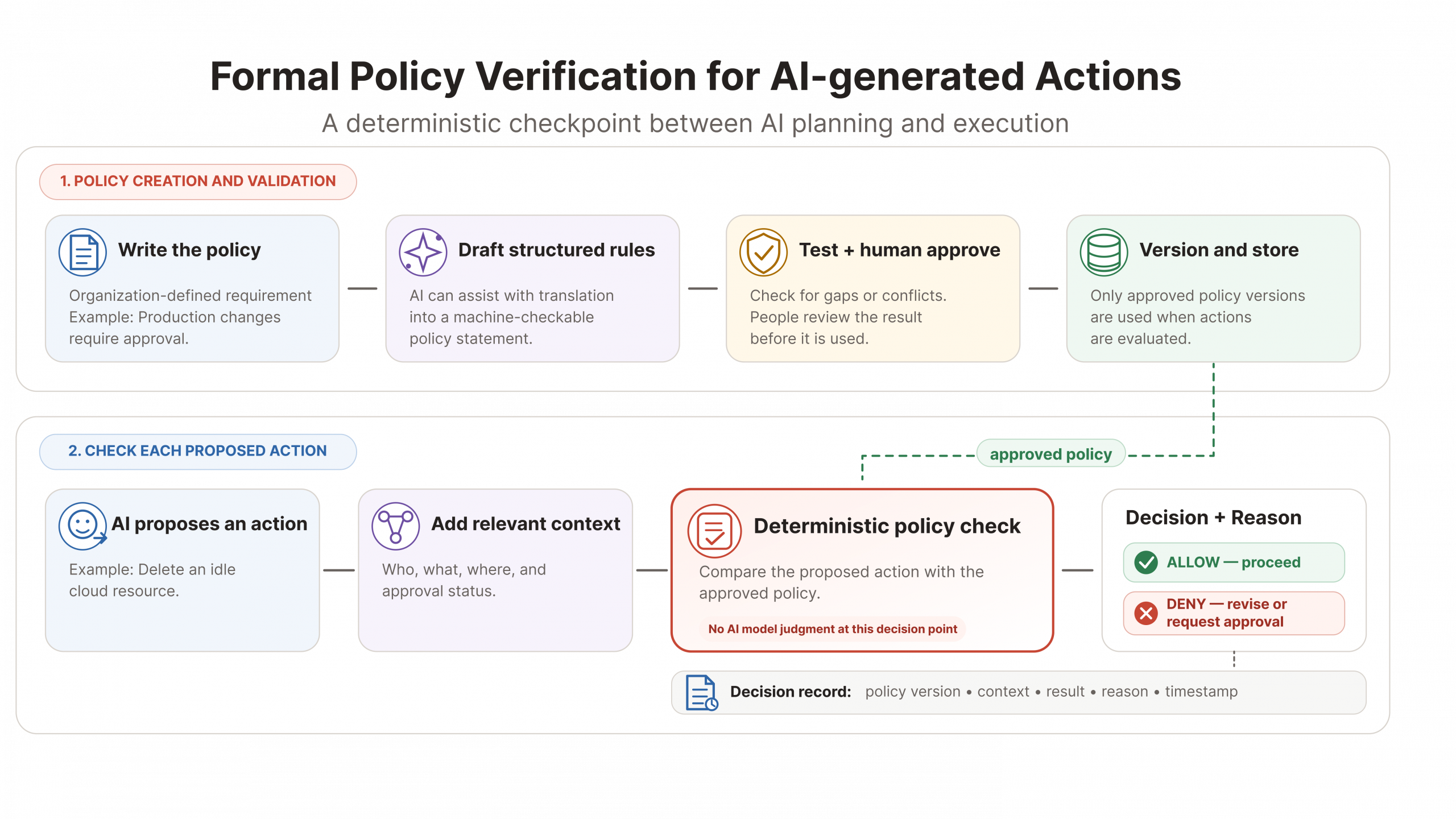
During policy authoring, a natural-language requirement can be mapped to an approved domain vocabulary and ontology. For example, “Do not delete production resources without an approved change request” can be mapped to defined concepts for the delete operation, production environment, and approval status, and then expressed as a machine-checkable rule. A large language model-based semantic parser can help generate a candidate policy in a canonical domain-specific language. A deterministic validator can then check syntax, vocabulary, types, required fields, and logical well-formedness.
Depending on the policy formalism and analysis tools, validated policy constraints can also be analyzed offline for consistency, conflicts, unreachable rules, missing cases, redundancy, and counterexamples. AI can help explain identified issues and generate candidate tests, but policy authors remain responsible for reviewing and approving the policy before deployment.
The approved policy, compiled constraints, analysis results, and relevant metadata can then be versioned and stored for runtime use.
At runtime, the request and proposed action can be normalized and converted into structured facts. A runtime decision engine evaluates those facts against approved, precompiled policies and returns ALLOW or DENY, together with the matched rule and reason. An integrated mediation layer can use that result to determine whether the action proceeds to the execution system. In this architecture, the large language model does not make the runtime policy decision. The decision, applicable policy version, relevant request context, explanation, and timestamp can be recorded to support oversight, troubleshooting, investigation, and audit activities.
How formal policy verification complements AI guardrails
AI guardrails and formal policy verification address different operational risks and can be used together.
| Layer | Strength | Example |
| AI guardrails | Analyze language, intent, ambiguity, sensitive information, and harmful content for configured risks | Detect prompt injection, harmful requests, potential exposure of personally identifiable information, or off-topic behavior |
| Policy verification | Deterministically evaluate structured actions against approved rules | Return a DENY decision when an operation conflicts with an applicable policy |
| Evidence layer | Support replay, investigation, oversight, and improvement | Record policy version, decision, reason, action facts, approval state, and trace |
AI guardrails help identify configured risks in a conversation, prompt, retrieved content, or generated response. Formal policy verification evaluates whether a structured action is permitted under explicitly defined policy. The evidence layer records relevant decisions and context to support oversight, investigation, and continuous improvement.
Potential Customer Value
A policy-verification component can provide potential value in three practical ways.
First, it can help reduce execution risk by blocking actions that do not satisfy specified policies before they reach tools, APIs, or downstream systems.
Second, it can help improve consistency by applying the same approved rules across similar requests, users, and resources.
Third, it can support audit and investigation activities by producing a structured decision record for each policy-relevant action.
Application owners and operators may gain additional policy controls for automated workflows. Security and risk teams may gain a machine-evaluable mechanism for applying customer-defined rules. Platform teams may be able to reuse the control pattern across selected workflows within a broader enterprise governance program.
The value of the pattern depends on factors including policy quality and coverage, the accuracy of contextual data, integration with execution systems, and the applicable approval and operating processes.
Looking ahead
As enterprise AI systems become more agentic, control architectures may expand from evaluating prompts and responses to mediating proposed actions.
A broader control architecture can include scoped identity, tool mediation, approval binding, budget limits, policy-as-code, runtime enforcement, monitoring, and decision records. The appropriate combination depends on the use case, risk tolerance, technical environment, and existing processes.
Formal policy analysis and deterministic verification can add a defined control layer to this architecture. They can help enterprises express selected requirements as machine-checkable rules and evaluate whether proposed actions are permitted before execution. The pattern may apply across cloud operations, software delivery, data access, business-process automation, and other selected agentic workflows.
This pattern does not replace AI guardrails, identity and access management, approvals, observability, or human oversight. It complements those controls. The objective is not to eliminate uncertainty from AI systems, but to apply explicit controls that can be tested and recorded around selected consequential actions.
Key takeaways
- AI-generated plans can be evaluated against approved policies before execution.
- A policy verification component evaluates structured actions against formally specified rules.
- AI can assist with candidate policy authoring, while policy authors remain responsible for review and approval and a deterministic engine makes the runtime policy decision.
- AI guardrails and policy verification address different risks and can be used together.
- Selected decision records can support traceability, oversight, troubleshooting, investigation, and internal audit activities, subject to appropriate data-handling requirements.