Oracle Cloud Infrastructure is a broad and deep platform with over 50 cloud services. The rich functionality enables customers to design cloud applications with optimal high availability, security, performance, and cost. Although the Oracle Cloud Infrastructure documentation site is a fantastic repository for service- and product-related content, we saw an opportunity to highlight “architecture assets.” These assets, which include reference architectures, best practices, sample code, design patterns, and training content, help you build more effectively in Oracle Cloud Infrastructure.
Today, we’re announcing the Oracle Cloud Infrastructure Architecture Center, which showcases technical content to help you build on Oracle Cloud.
What’s in the Architecture Center
We’ve reorganized some of our existing content into logical groupings:
- Reference architectures
- Quick starts
- Solution guides
- Getting started
- Learning resources
- Blog posts

Our goal for the Architecture Center is to provide an optimal navigational experience focused on real use cases and customers. For example, customers often tell us that they want to understand how to use our services to design and deploy solutions. So, we made a section dedicated to solution guides that cover Oracle solutions—such as E-Business Suite, JD Edwards, PeopleSoft, and AgilePLM—as well as modern cloud native solutions. We also want to make it easier for customers to learn how to use our technology. So, we have sections devoted to getting started and learning resources, covering L50 (Foundation) and L100-L300 technical content and hands-on-labs.
Launching the First 20 Reference Architectures
An important goal of the Architecture Center is to provide best practices for applications on Oracle Cloud Infrastructure. To make this guidance more accessible, we’re launching a library of reference architectures for some of the most common application stacks and architecture patterns. These architectures provide recommendations and considerations for designing your applications. The following list provides links to the first 20 available architectures.
| Category |
Reference Architecture |
| Networking |
|
| Cloud native |
|
| Database |
|
| Scalability |
|
| Deploy a high-performance storage cluster using IBM Spectrum Scale |
You can find more as they are released by going directly to the Reference Architectures page. New architectures are released every week, and they’re translated into 11 languages!
Detailed Diagrams and Recommendations
Although thorough, our technical content can be overwhelming. Most of the time, you’re learning new technology on the go, so we wanted to keep these reference architectures limited to 2-3 pages. Because many people learn more from looking at diagrams than from reading text, every architecture includes at least one diagram that shows the various components and their interactions, using a standard set of icons.
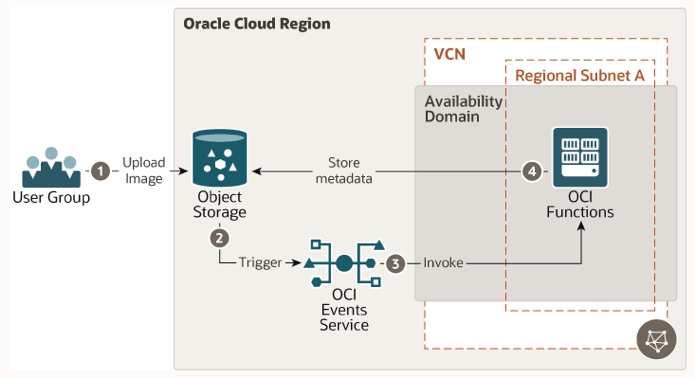
Every reference architecture also includes recommendations and considerations for your implementation, including guidance for availability, security, performance, and cost.
Terraform Deployments
We can’t have a real-life reference architecture without a deployable solution. Wherever applicable, we’re releasing Terraform code that you can easily download, modify, and deploy in your own accounts. You can use Oracle Cloud Infrastructure Resource Manager, a managed infrastructure-as-code offering based on Terraform, to share and manage configurations and state files across multiple teams and platforms and go beyond local Terraform installations.
These Terraform deployments are part of a collection of more than 60 quick-start templates that deploy complex software stacks from our partners and community. These templates include solutions for H2O, Kinetica, SAS, Splunk, Hortonworks, and others and are intended to get you started using Oracle Cloud Infrastructure. You can customize these solutions to form the basis of a more complex deployment.
We hope that you find the Architecture Center useful! Please send us your feedback at oci-enablement_us_grp@oracle.com.